Will the Holy Roman Empire Rise Again
The absence of the Roman Empire fueled Western culture, Stanford scholar says
Zero similar the Roman Empire e'er emerged once again – which was a adept thing, says Stanford historian Walter Scheidel. Here, he explains why.
Why the Roman Empire fell is often discussed in history classes and textbooks. Simply new research past Stanford historian Walter Scheidel considers an angle that has received footling scholarly attention: Why did it – or something similar to it – never emerge again?

Stanford historian Walter Scheidel calls the fall of Rome the "bully escape." (Image credit: Daniel Hinterramskogler)
Scheidel discusses in a new book why the Roman Empire was never rebuilt and how pivotal its absence was for modernistic economical growth, the Industrial Revolution and worldwide Western expansion. Freed from the clutches of an majestic monopoly, Europeans experimented and competed, innovated and collaborated – all preconditions for the world we at present inhabit, he said.
Scheidel, the Dickason Professor in the Humanities and a Catherine R. Kennedy and Daniel L. Grossman Boyfriend in Homo Biology, is author of Escape from Rome: The Failure of Empire and the Road to Prosperity (2019). He likewise edited The Science of Roman History: Biological science, Climate and the Future of the Past (2018).
The collapse of the Roman Empire is considered past many to be 1 of the greatest disasters in history. But you fence that Rome'south dramatic collapse was actually the best thing that ever happened. How and then?
The disintegration of the Roman empire freed Europe from rule by a single ability. Imperial monopolies provided peace and stability, but by seeking to preserve the status quo also tended to stifle experimentation and dissent. When the stop of empire removed centralized control, rival political, armed forces, economical and religious constituencies began to fight, deal and compromise and – in the procedure – rebuilt society along different lines.
Those ane,500 years (all the mode upwardly to Earth War II) were full of conflicts equally Europe splintered into a violently competitive land arrangement. Merely for all the suffering it caused, this fragmentation and competition fostered innovation that eventually gave rise to unprecedented change in knowledge production, economic operation, human welfare and political affairs. This path to modernity was long and tortuous, but as well unique in the world.
In dissimilarity to other large-calibration empires – such as the successive dynasties in China – the Roman empire never returned to Europe. Why was that?
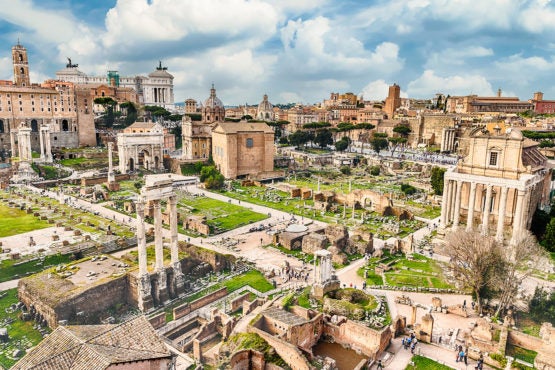
Stanford Professor Walter Scheidel says the autumn of the Roman Empire enabled the rise of Western civilization. (Image credit: bwzenith / Getty Images)
An overly simple reply would be that all after attempts to restore universal empire on European soil failed. Just was that just an accident? I debate that it wasn't: there were powerful environmental reasons for Europe'due south lasting fragmentation. Europe lacks large river basins that supported centralized ability elsewhere and it is shaped by mountain barriers and exceptionally long coastlines that carve it up into smaller units. Perhaps nearly importantly, Western Europe is far removed from the great Eurasian steppe, grasslands that used to house warlike nomads who played a critical function in the cosmos of large empires in Russian federation, the Center East, and S and E Asia. Although these features did not determine historical outcomes, they nudged European state formation onto a different trajectory of greater diversity.
What made the Roman Empire so successful?
If Europe wasn't fertile footing for empire-building, we may wonder why the Roman Empire existed at all. The Romans succeeded past exploiting a set of atmospheric condition that were hard or even impossible to replicate later on on. Through shrewd manipulation of borough obligations, fabric rewards and alliances, their leadership managed to mobilize vast numbers of ordinary farmers for military operations at depression cost.
Rome likewise benefited from modest levels of land formation in the western Mediterranean and the fact that larger kingdoms farther due east were decorated fighting each other. This immune them to overpower and swallow other societies one by one. In later periods, past contrast, Europe was full of competing states that prevented any one of them from subduing all the others.
What were the efforts to rebuild the Roman Empire, and why did they fail?
Such efforts began near immediately when the eastern Roman Empire tried to recover the western provinces that had fallen to Germanic conquerors. Ii-hundred-and-50 years afterwards, the Frankish ruler Charlemagne styled himself equally a Roman emperor, and later in the Heart Ages an unwieldy entity known as the Holy Roman Empire of the German Nation appeared on the scene. However, none of these projects succeeded in re-creating an empire of Rome's size, power or durability.
Later on efforts by the Habsburgs and past Napoleon to found some degree of hegemony over Europe failed likewise. Several factors were responsible for this. In the Middle Ages, the erosion of purple power and revenue enhancement brought nearly by the rising of landed aristocracies interfered with country building. By the early modern catamenia, the European land organisation had already become also deeply entrenched to be dislodged past whatever one power and would-be conquerors were reliably stymied by alliances that checked their ambitions.
You devote your epilogue to Monty Python's natural language-in-cheek question, "What have the Romans always washed for us?" So what does the modern world owe to the ancient by?
Nosotros normally focus on the legacies of Roman culture that are still visible today, from the Romance languages, the Roman writing arrangement and many proper names to the Julian calendar, Roman constabulary, architectural styles, and, concluding simply by no means least, the various Christian churches. All of these proceed to shape our lives.
But when it comes to explaining why the world has changed then much over the last couple of centuries, the single most of import contribution of the Roman Empire turns out to have been that it went away for good and zip similar information technology ever returned. This rupture was disquisitional in allowing the right conditions for transformative alter to emerge over time. Sometimes the most important legacy is the one we cannot see!
Source: https://news.stanford.edu/2019/10/23/fall-rome-europes-lucky-break/

Post a Comment for "Will the Holy Roman Empire Rise Again"